

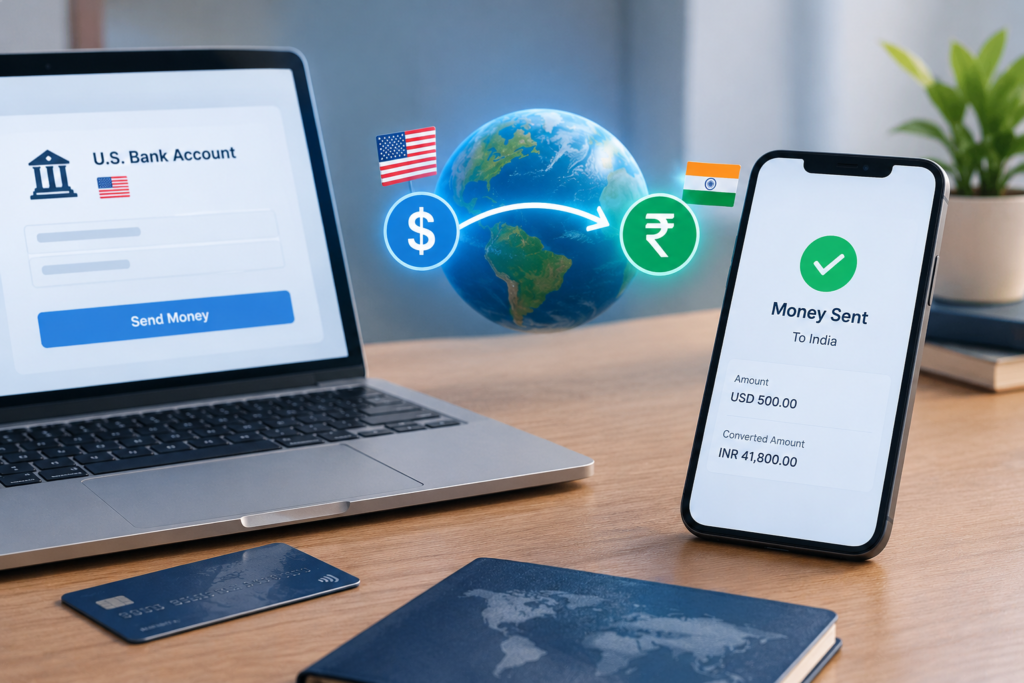
Imagine your parents in India need money urgently, but the person receiving it does not have an active Indian bank account. You may assume that sending money from the USA is impossible without traditional banking details. In reality, there are other ways to receive an international remittance, including cash pickup and certain digital payout options.
The key is to use an authorized and compliant remittance service that verifies the sender and recipient before releasing the funds. This makes it possible to send money to India without relying entirely on a traditional bank-to-bank transfer.
How Money Transfers Work Without an Indian Bank Account
Available Non-Bank Transfer Options
One of the most common alternatives to a bank account is cash pickup. Depending on the remittance provider and the payout network available in the recipient’s location, the recipient can collect the money from an authorized partner outlet in India.
The recipient generally needs a valid government-issued photo ID and the transaction reference or PIN provided by the sender. The name entered during the transfer should match the recipient’s legal name on their identification document.
Some providers may also support digital or mobile-based payout options where available. These options can allow funds to be credited through an eligible digital channel instead of requiring a conventional bank account. Availability depends on the service provider, the payout partner and applicable Indian regulations.
The important point is that the absence of a traditional bank account does not automatically prevent someone from receiving money from the USA.
USA-to-India Specific Remittance Standards
When sending money from the USA to India, the transaction still needs to pass the required identity, compliance and anti-money-laundering checks. The exact process depends on the remittance provider and the payout method selected.
For a more detailed look at the specific requirements when the recipient does not have an Indian bank account, you can explore [Can You Send Money USA to India Without Having an Indian Bank Account?].
It is also important not to confuse incoming USA-to-India transfers with India’s Liberalised Remittance Scheme, or LRS. LRS primarily governs eligible outward remittances by resident individuals from India and has a limit of USD 250,000 per financial year. It is therefore not a general limit on money being sent from the USA into India.
Identification & KYC Requirements for Non-Account Beneficiaries
KYC is an important part of a non-bank payout. A recipient may be required to present a government-issued photo ID, such as an Aadhaar card, Passport or Voter ID, depending on the payout partner’s requirements.
The recipient may also need a transaction reference number, MTCN or PIN. Some digital channels may require OTP verification before funds are released.
These checks are designed to ensure that money reaches the intended recipient. They also reduce the risk of fraud, impersonation and unauthorized collection.
Rejections and Holds: What Happens When Non-Bank Transfers Fail
A non-bank transfer can be held or rejected if the information provided during the transaction does not match the recipient’s identification documents. Even a small difference in the legal name can create a verification issue.
Other triggers can include incomplete KYC information, incorrect recipient details, unusual transaction patterns or limits imposed by the payout network. In some situations, intermediary processing entities may need additional information before releasing the funds.
A hold does not necessarily mean the money has been lost. It usually means the transaction requires additional verification or correction before it can proceed.
If you want to understand the wider circumstances in which an India-bound transfer can be questioned or rejected, read [Can an Indian Bank Reject Money Sent From the USA?].
The best way to reduce these problems is to enter the recipient’s details exactly as they appear on their government-issued ID and carefully review the transfer before confirming it.
Bank Holidays & Payout Processing Timelines
Bank and public holidays can affect the availability of physical payout locations and certain digital processing networks in India. A cash pickup outlet may have different operating hours on national, regional or local holidays.
This is different from a compliance hold. A holiday-related delay generally means the payout cannot be processed until the relevant location or network becomes operational again. It does not automatically mean that the transfer has been rejected.
If the recipient needs the money around a holiday, it is sensible to check the operating hours of the selected payout location in advance.
For more information on how holidays can affect a USA-to-India transfer, refer to Can a USA-to-India Transfer Be Sent on a Bank Holiday in India?.
Essential Record Keeping for Non-Account Transfers
Keeping proper records is particularly important when money is collected outside a traditional bank account. The sender should retain the transfer receipt, transaction reference number, amount sent, exchange-rate information and recipient details.
The recipient should also keep their payout receipt and any relevant identification or verification records.
Good documentation makes it easier to resolve discrepancies if a transfer is delayed, held or questioned later. It can also help demonstrate the source and purpose of funds if additional verification is requested.
For a practical record-keeping checklist, read What Records Should You Keep for Money Sent From the USA to India?.
It is also useful to remember that TCS under Section 206C(1G) is primarily associated with specified outward remittances under India’s LRS framework. It should not be automatically treated as a tax on ordinary money being sent from the USA to India.
Frequently Asked Questions (FAQs)
Is a recipient in India required to open a bank account to receive USD transfers?
No. A recipient may be able to receive money through an authorized cash pickup location or an eligible digital payout channel without opening a traditional bank account. The recipient will generally need to complete the required identification and verification process.
What happens if the recipient’s name on their ID does not match the transfer details?
The payout may be placed on hold until the discrepancy is resolved. Depending on the provider, the sender may need to correct the recipient’s name so that it matches the government-issued identification exactly.
Are non-bank account transfers from the USA to India safe?
Yes, when you use a trusted and compliant remittance service that follows appropriate security, KYC and anti-fraud procedures. The safest approach is to use a provider that clearly explains the transaction process, fees, exchange rate and payout requirements before you send the money.
Conclusion & Strategic Summary
Sending money to India without an Indian bank account can be straightforward when the right payout method is available. Cash pickup and eligible digital options can provide alternatives to traditional bank transfers, provided the recipient completes the required verification.
With a compliant service such as Abound, you can send money from the USA to India with greater confidence, clear transaction information and appropriate security throughout the process.