

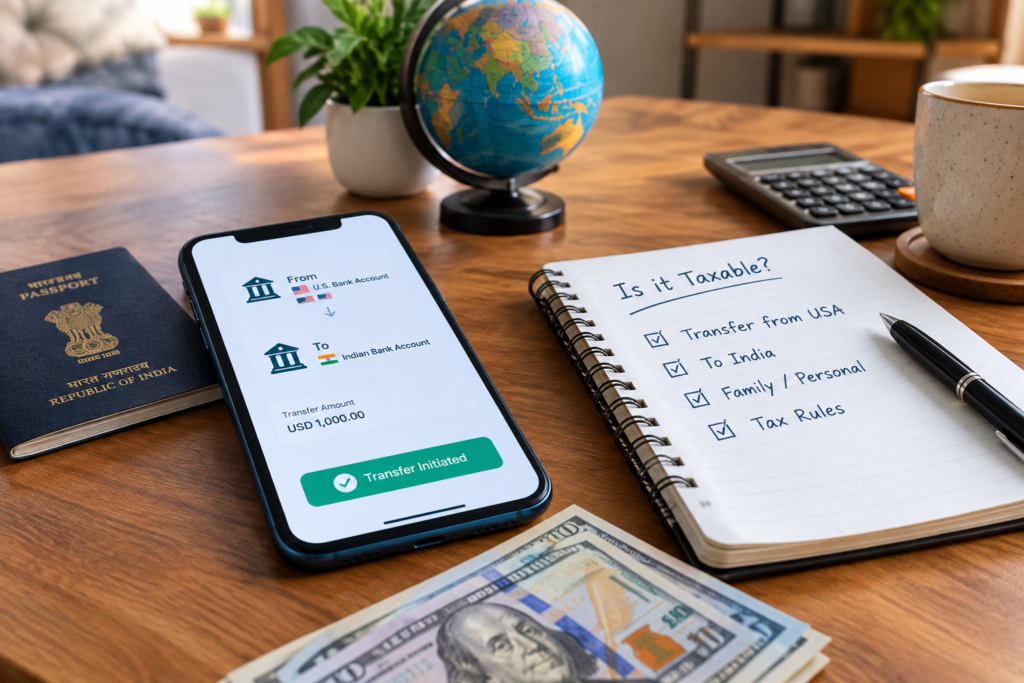
You send money from the USA to your parents in India every month. It comes from your salary, taxes have already been paid on that income, and you are simply helping your family with their expenses. Then a question comes up: does your family have to pay tax in India just because the money came from the USA?
In many family situations, the answer is no. Money received as a genuine gift from a specified relative is generally not taxable in the recipient’s hands under Section 56(2)(x) of the Income Tax Act, 1961. However, the tax treatment can change depending on who receives the money, why it is being sent and what happens to the funds after they are received.
Understanding these distinctions can make USA-to-India family remittances much easier to manage.
Key Tax Rules for Money Sent From USA to Family in India
Tax Exemption for Specified Relatives (Section 56(2)(x))
Section 56(2)(x) provides an important exemption for gifts received from specified relatives. This means a genuine monetary gift from a qualifying relative is generally not taxable in the recipient’s hands, regardless of the amount.
The definition of “relative” is broader than just immediate family. It includes relationships such as a spouse, brother or sister, brother or sister of the spouse, brother or sister of either parent, and certain lineal ascendants or descendants of the individual or spouse.
So, if you send money from the USA to your parents in India as a genuine gift, the receipt is generally not taxable under Section 56(2)(x). The same principle can apply to other qualifying relatives covered by the statutory definition.
However, it is important to distinguish the gift itself from income generated by that gift. For example, if your parent invests the gifted money and earns interest or dividends, that subsequent income may be taxable according to the applicable tax rules.
Gifting to Non-Relatives & the ₹50,000 Threshold
The treatment is different when money is gifted to a friend or another person who does not qualify as a specified relative.
Under Section 56(2)(x), monetary gifts received without consideration can become taxable when the aggregate value of such gifts exceeds ₹50,000 during the relevant financial year. Importantly, where the threshold is crossed, the applicable amount is generally the aggregate value of the taxable gifts, rather than only the portion above ₹50,000.
The recipient may then have to report the taxable amount under “Income from Other Sources” and pay tax at the applicable rate.
There are exceptions and specific categories of gifts that can receive different treatment, so the relationship between sender and recipient should be established before assuming that a transfer is tax-free.
US IRS Compliance & Gift Tax Reporting (Form 709)
The U.S. tax treatment is a separate question from Indian tax treatment. A person living in the USA may need to consider U.S. federal gift-tax reporting rules even when the recipient is in India.
For 2026, the U.S. annual gift-tax exclusion is $19,000 per recipient. The exclusion applies to qualifying gifts to each donee, subject to the applicable rules.
Going above the annual exclusion does not automatically mean that the sender immediately owes gift tax. It can instead create a reporting obligation and may require Form 709, the U.S. Gift and Generation-Skipping Transfer Tax Return. The IRS specifically uses Form 709 to report transfers subject to federal gift tax rules and to account for applicable exemptions.
Because U.S. gift-tax rules depend on factors such as citizenship, residency, the nature of the gift and the recipient, larger transfers should be reviewed with a qualified tax professional.
Alternate Non-Bank Payout Mechanisms
Tax treatment generally depends on the nature of the transaction rather than simply whether the recipient receives money in a bank account. Authorized cash pickup or other eligible payout mechanisms do not automatically change whether a payment is considered a gift.
The recipient should still retain appropriate proof showing who sent the money, who received it and the purpose of the transaction.
For family members who may not have an active Indian bank account, understanding alternative receiving options can be useful, especially when planning regular support from abroad. You can explore Can You Send Money to India Without Having an Indian Bank Account? for more information.
What Causes Tax Flags & Rejections at Indian Banks
Receiving money from the USA does not automatically make a transaction taxable or suspicious. However, Indian banks may review international transfers to meet regulatory and compliance requirements.
Issues can arise when the transaction contains incomplete beneficiary information, an unclear purpose, inconsistent sender details or information that requires additional verification. Banks may also ask for documentation relating to the source or purpose of funds in certain circumstances.
Purpose codes can be important because they help classify the nature of an inward remittance. KYC requirements and other compliance checks can also apply to the sender or recipient depending on the transaction and institution.
A bank hold is therefore not necessarily a tax assessment. It can simply mean that additional information is needed before the transaction can be processed.
If you want to understand the circumstances in which an Indian bank can hold, reject or return an international transfer, you can explore Can an Indian Bank Reject Money Sent From the USA? for a broader explanation.
Impact of Bank Holidays on Processing Schedules
Bank holidays can affect the operational processing of an international remittance, but they do not automatically create a tax liability.
A transfer initiated from the USA may reach a processing stage while the relevant Indian bank or branch is closed. In such cases, the transaction may remain in a processing queue until the applicable banking operations resume.
This should be distinguished from a compliance hold. A bank holiday does not mean that the transaction has been selected for a tax audit or rejected because of taxation concerns.
If you are planning a family transfer around a weekend or public holiday, understanding the difference between submission, processing and account crediting can help you interpret the transaction status correctly. You can learn more through [Can a USA-to-India Transfer Be Sent on a Bank Holiday in India?].
Crucial Documentation & Record Keeping for Tax Compliance
Keeping clear records is one of the simplest ways to explain a family remittance if questions arise later. Retain the transaction receipt, foreign bank statement, transaction reference, beneficiary details and any available remittance or purpose-code documentation.
For larger family gifts, a written Gift Deed can also provide additional evidence of the nature and intention of the transfer. It can be particularly useful where the amount is substantial or the transaction may need to be explained to a bank, tax authority or financial institution.
The documentation should clearly establish that the money was intended as a gift rather than payment for services, a loan or another type of transaction.
For a practical record-keeping checklist, you can refer to [What Records Should You Keep for Money Sent From the USA to India?].
Frequently Asked Questions (FAQs)
Is money sent from the USA to my parents in India taxable?
Generally, no. Money received by parents as a genuine gift from their child can qualify for the specified-relative exemption under Section 56(2)(x), so the gift itself is generally not taxable in their hands in India. The exemption applies subject to the statutory conditions.
What happens if I send money to a friend in India exceeding ₹50,000?
If gifts covered by Section 56(2)(x) from non-relatives exceed the applicable ₹50,000 threshold during the financial year, the aggregate taxable gift amount can become taxable in the recipient’s hands under “Income from Other Sources.” Certain exceptions may apply.
How can I ensure my USA-to-India transfers are compliant and secure?
Use a trusted transfer service such as Abound, provide accurate recipient information and select the correct transaction purpose. Keep receipts and supporting documents, particularly for recurring or high-value family transfers. Good documentation supports transparency and can help address questions from financial institutions.
Conclusion & Strategic Summary
Sending money from the USA to family in India is generally straightforward when the transfer is a genuine gift to a specified relative and the transaction is properly documented. The key is to distinguish the tax treatment of the gift from any income generated after the money is received.
For non-relatives, the ₹50,000 threshold under Section 56(2)(x) becomes important. U.S. gift-tax reporting is a separate consideration, particularly for larger gifts.
With Abound, you can manage USA-to-India family remittances with a focus on secure transactions, transparency and clear transaction information.